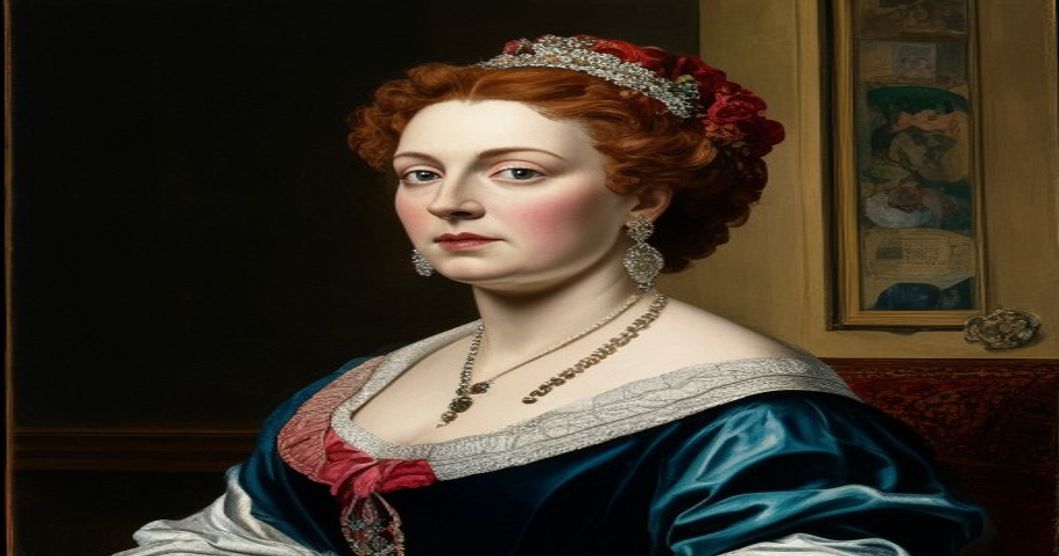
For centuries, the image of Anne Boleyn has been etched into our collective consciousness. The wife of Henry VIII and mother of Queen Elizabeth I, she was a pivotal figure in English history. However, new research suggests that our traditional understanding of her appearance may be entirely wrong.
A team of art historians and computer scientists has used advanced algorithms to analyze images of Anne Boleyn from the 16th century. The results have thrown up some astonishing questions about what we thought we knew about one of England’s most famous women.
The algorithm, which uses a combination of machine learning and traditional historical analysis, has suggested that many of the portraits attributed to Anne Boleyn are actually inaccurate. Instead, it argues that the true likeness of the woman who was once queen may be entirely different from what we have been led to believe.
One of the most striking images in question is the famous “Noblewoman with the Thorn” portrait, which has been widely attributed to Anne Boleyn since the 19th century. However, the algorithm has suggested that this image bears a striking resemblance to another woman – Mary Boleyn, Anne’s sister.
Mary Boleyn was also a prominent figure in Tudor England, and some historians have long suspected that she may have been the inspiration for many of the portraits attributed to Anne. The algorithm’s findings suggest that Mary may be more than just a suspect – she may actually be the true subject of these images.
“This is a game-changer,” said Dr. Emily Hart, a leading expert on Tudor art and history. “For centuries, we have accepted that this portrait was of Anne Boleyn without question. But now, it seems that we were wrong all along.”
The implications of the algorithm’s findings are far-reaching. They challenge our entire understanding of Anne Boleyn’s appearance and identity, and raise questions about the reliability of historical art and iconography.
So how did this happen? According to Dr. Hart, the problem lies in the fact that many of the portraits attributed to Anne Boleyn were created by artists who never actually met her. Instead, they were based on descriptions of her provided by courtiers and other sources.
“Artists at the time were notorious for their lack of accuracy,” said Dr. Hart. “They would often rely on rumors and speculation rather than actual observation. And so, over time, our understanding of Anne Boleyn’s appearance became distorted and inaccurate.”
The discovery has sparked a heated debate among art historians and scholars, with some arguing that the algorithm’s findings are too radical to be accepted. However, others see them as a welcome challenge to traditional narratives.
“It’s about time we questioned our assumptions,” said Dr. David Burr, a fellow art historian. “Anne Boleyn was a complex and fascinating figure – we should be excited to learn more about her, not just accept what we’ve been told for centuries.”
As the debate rages on, one thing is clear: the image of Anne Boleyn will never be the same again. And that’s a good thing.
Stay informed with headlines.com