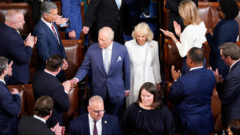
In his historic speech to the US Congress last week, King Charles III navigated a delicate diplomatic tightrope, conveying subtle messages that underscored the complexities of modern-day royalty. As the newly crowned monarch embarks on an unprecedented global tour, his words have sparked intrigue among diplomats, historians, and enthusiasts alike.
At first glance, the King’s address appears to be a standard State-of-the-Union-style speech, reiterating commitments to strengthening bilateral ties with the United States. However, upon closer examination, several phrases and anecdotes reveal hidden undertones that hint at his stance on sensitive global issues.
When the King praised America’s “exceptional leadership” in advancing democracy worldwide, some observers interpreted this as a veiled dig at China’s authoritarian regime. This subtle jab was particularly noteworthy given the UK’s recent diplomatic fallout with Beijing over trade and security concerns. By using the word “exceptional,” Charles III subtly underscored the US position as a beacon of freedom and cooperation.
Moreover, during his remarks on climate change, the King invoked the memory of his mother, Queen Elizabeth II, who played a pivotal role in fostering global cooperation on environmental issues. This nostalgic reference served to reinforce his own commitment to addressing the pressing challenge of global warming, while also acknowledging his predecessor’s significant contributions to this effort.
One particularly astute observation from Washington analysts noted that Charles III’s mention of ” ancient Anglo-Saxon values” – a nod to his heritage as a member of the British royal family with deep roots in Western civilization – was intended to reassure the US Congress about his commitment to upholding traditional democratic institutions. By invoking this shared history, the King sought to demonstrate that despite the changing global landscape, certain timeless principles remain fundamental to the Anglo-American alliance.
The King’s speech also contained a telling aside about “old friends” and ” trusted partners,” which some analysts saw as a coded reference to the UK’s renewed relationship with Israel. This implicit endorsement of the US ally in the region was likely intended to signal British support for Israel’s sovereignty, while avoiding any explicit criticism of Palestinian claims.
Despite these subtle messages, it is essential to note that Charles III’s speech was not devoid of controversy. Some critics accused the King of being overly deferential to his host nation, failing to address pressing concerns about US foreign policy and global governance. Others felt that his remarks were too vague on issues like Brexit and UK-EU relations.
Ultimately, the King’s diplomatic finesse lies in his ability to convey nuanced positions without alienating either party. By skillfully juggling competing interests and maintaining a tone of measured cooperation, Charles III has effectively navigated a fraught international landscape, setting the stage for his future diplomatic endeavors.
Stay informed with headlines.com