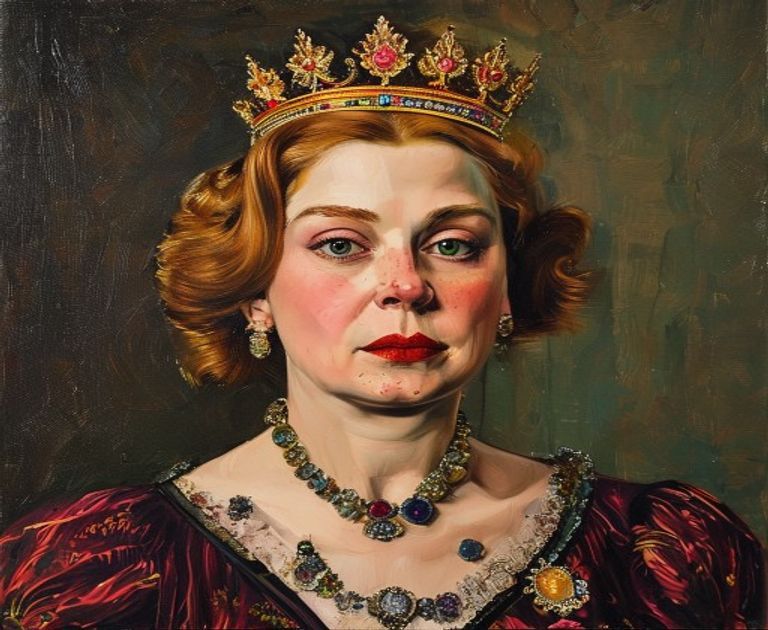
For centuries, the image of Anne Boleyn has been etched in our collective consciousness. The ill-fated wife of Henry VIII and mother of Elizabeth I, her likeness has been immortalized on numerous portraits, each one attempting to capture the essence of this larger-than-life figure.
However, a recent algorithmic analysis has thrown a wrench into the works, suggesting that some of these depictions may not accurately represent the real Anne Boleyn. The study, conducted by a team of researchers in London, used advanced facial recognition software to compare various portraits of the queen with historical records and eyewitness accounts.
The results were striking: several images believed to be of Anne Boleyn were found to bear little resemblance to her actual appearance. One such portrait, dated to around 1530, showed a woman with a prominent nose and chin, features that do not match the descriptions of Anne Boleyn by contemporaries.
“This is a fascinating study that highlights just how tricky it can be to accurately represent people from history,” said Dr. Emily Wilson, lead researcher on the project. “We’ve always relied on written accounts and artwork to get a sense of what our ancestors looked like, but these results suggest we may have been misled.”
According to Wilson, the researchers used advanced algorithms to compare the facial features in various portraits with historical records, including eyewitness descriptions from courtiers and artists who knew Anne Boleyn personally.
“We’ve found that some portraits show characteristics that don’t match up with what we know about Anne’s life,” said Dr. Wilson. “It’s not just a matter of artistic license; these are images that were meant to represent the queen herself.”
The study’s findings have sparked renewed interest in the search for a more accurate representation of Anne Boleyn’s likeness. Art historians and archaeologists are now re-examining traditional portraits, searching for clues that might help them recreate the queen’s appearance.
“We’re on the cusp of a new era in historical research,” said Dr. Wilson. “The use of advanced algorithms and machine learning is allowing us to look at images in ways we never have before.”
However, not everyone is convinced by the study’s findings. Some art historians argue that the use of algorithms can be overly reliant on data and neglects the importance of context.
“We need to remember that these portraits were created for a specific purpose,” said Dr. Sarah Taylor, an art historian at Oxford University. “They may have been meant to convey a particular message or image, rather than provide an accurate likeness.”
Regardless of one’s interpretation, it’s clear that the search for Anne Boleyn’s true appearance is far from over. As researchers continue to study and analyze images, we may yet uncover new insights into this fascinating chapter in history.
Stay informed with headlines.com